Hey there, I’m Jake, part of the team that builds, troubleshoots, and supports industrial welding robots for customers across the manufacturing space. For the last six years, I’ve sat through more breakdown calls, on-site emergency fixes, and late-night trainings than I can count—and one issue that pops up way more than it should is electromagnetic interference (EMI) messing with these welding robots. If you’re running a production line, this isn’t just a “minor glitch”—it’s lost parts, messed-up welds, and even unexpected downtime that costs you serious cash. Let me break this down like I talk to my clients, no stuffy lab jargon (okay, maybe a tiny bit, but I’ll explain it like we’re grabbing a coffee). Welding Robot
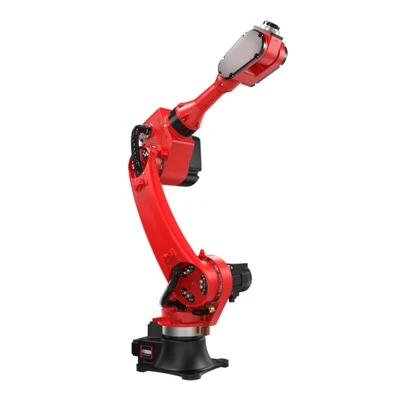
First, let’s get on the same page: what’s EMI in this context? For our welding robots, it’s when the super strong electrical signals from the welding process itself mess with the robot’s brain (that’s the controller), its drives, or even other nearby machinery. Welding already cranks out a lot of juice—we’re talking 100s of amps, high voltage, and constantly switching signals as the welding arc moves. That’s like a giant radio transmitter that’s supposed to be doing work, but its “signal bleed” messes with the robot’s own wiring. I’ve seen this go from annoying to catastrophic in 10 minutes flat.
The most common spot this hits? The robot’s teach pendant. That little handheld controller that your operators use to program weld paths? I’ve had calls where a welder was trying to set a seam, and suddenly the teach pendant’s buttons stopped responding, or the robot lurched to a totally different spot mid-program. Last quarter, a automotive parts plant in Detroit hit us with this: their line was welding chassis frames, and every time they got to a spot weld at the rear axle, the robot would veer 2 inches off mark. Turns out the welding transformer for that station was grounded improperly, so the EMI was leaking straight up the pendant cable. We fixed their ground, but if they’d known about this upfront, they could’ve avoided 8 hours of lost production.
Another big one: internal robot components. The servo drives that move the robot’s arms? They’re super sensitive to voltage spikes from EMI. I’ve seen servo drives lock up entirely, or even burn out, because the welding arc’s EMI was coupling with the drive’s power lines. A client in Ohio that makes agricultural equipment had a $12k servo drive fry because their robot was too close to a unshielded welding power source—they thought just moving the robot a foot away would fix it, but no, the EMI was traveling through the air and the plant’s metal floor. Even the robot’s main controller can get wonky: we had a small fabricator in Texas where the controller’s display would freeze every time they ran a long seam weld. It took us pulling the controller’s wiring loom to find that a 24V control line was running right parallel to a high-voltage welding cable—no shielding, so EMI was bleeding through.
Wait, and it’s not just the robot—EMI messes with other stuff on the line too. I’ve had clients complain that their barcode scanners next to the welding station quit working, or even their ERP system’s data entry lagged. But since this is a welding robot blog, let’s stay focused: the robot’s own performance is the priority here. Bad EMI means inconsistent welds—think porosity, incomplete penetration, or even splatter that you don’t want. For aerospace or medical device parts, that’s a total scrap, not just a do-over. I remember a medical equipment maker in California who had to scrap 200 hip replacement parts because their robot’s welds were off by a fraction of a millimeter, all because EMI was messing with the weld path during final assembly.
Now, why does this happen so often with welding robots specifically? Let’s be real: other industrial robots (like pick-and-place) use lower power signals, not the 100-1000A AC that a welding arc generates. The welding process itself is inherently noisy—every time the arc strikes, there’s a brief, intense electrical surge that acts like a lightning bolt for the robot’s electronics. Add in that many older welding setups don’t have proper shielding or grounding, and boom—you’ve got an EMI disaster waiting to happen. I see a lot of clients skip adding shielded cables to their robot’s wiring, or they run welding cables and control cables in the same tray. That’s a huge mistake; unshielded cables are like an antenna for EMI.
So what can you actually do about this? I’m not here to sell you a new robot every time you have a glitch—we’ve fixed tons of EMI issues on existing setups. First, check shielding and cable routing. If your robot’s control cable isn’t shielded, swap it for a double-shielded one. And never run control or teach pendant cables alongside welding power cables—give them at least a 12-inch gap, or use metal conduit to separate them. Second, grounding is non-negotiable. We see so many plants with flimsy grounds for their welding stations. A proper ground should be a heavy-gauge copper wire, connected directly to the plant’s main ground bus, not just a random bolt on a metal frame. Last, maybe add a line filter for the robot’s power supply. Those are like a sponge for EMI—they catch the voltage spikes before they get to the controller or drives. We usually recommend them as standard for any welding robot going into a high-production welding environment.
Wait, I should also be transparent: sometimes it’s not the client’s setup, it’s our robot’s design. Early on, when we launched our first line of welding robots, we skipped a few shielding layers to cut costs (don’t judge, we were a small company back then). We learned fast—after 12 customers had EMI issues, we re-engineered the control module to add better internal shielding and updated our cable harnesses to include shielded pairs. That’s why now, every robot we sell comes with pre-tested EMI mitigation built in, but it’s still up to integrating it with your welding station right.

Let me leave you with a real example from last month: a client in Indiana that builds heavy construction equipment called us panicking because their new welding robot was freezing mid-weld every time they ran a 6-inch thick steel plate. We showed up, ran an EMI test, and found that their welding power source was mounted too close to the robot’s base, and their ground was a 10-year-old bolt that was rusted. We tightened the ground, added a shield between the welding power source and the robot, and moved the cables—done. No more freezes, 100% uptime. That’s the stuff we deal with every day.
Welding Robot If you’re experiencing this kind of issue, or you’re looking to install a new welding robot and want to avoid EMI headaches down the line, hit us up to chat. We can walk through your setup, run a quick on-site test, and figure out exactly what you need to keep your production line running smooth. Don’t let EMI cost you money—let’s work together to fix it before it becomes a big problem.
References
- Welding Industry Electromagnetic Compatibility (EMC) Guidelines, American Welding Society, 2021
- Industrial Robot Electromagnetic Interference Mitigation, International Society of Automation, 2020
- EMI Effects on Servo Drives for Industrial Robotics, Motion Control Association, 2019
Robotic Technology (GD) Co., Ltd.
Robotic Technology (GD) Co., Ltd. is one of the most experienced welding robot manufacturers and suppliers in China, also supports custom service and one year warranty. Please feel free to wholesale CE approved welding robot for sale here from our factory. Contact us for quotation.
Address: Room 102, No. 30,Hengfeng 2nd Road,Daguo, Changping Town, Dongguan City,Guangdong,China
E-mail: admin@iroboticplus.com
WebSite: https://www.rb-tic.com/
